5/02/2007

Our troops need our support


Last November, I had prepared an audio clip that was aired on Entre les 2 lignes that I was co-hosting at the time. A few days prior to that, I had my father listen to it. Dad is a WWII vet. He had asked me to burn it on a CD so he could share it with at the Legion with other members. He had a lot of good works on it and told me about them.

Being myself a former army cadet, #2725 of the Fusillers Mont-Royal, I had the ambition to follow in a military career. Unfortunately, the recruiting officers decided otherwise and I stayed in the civilian life.

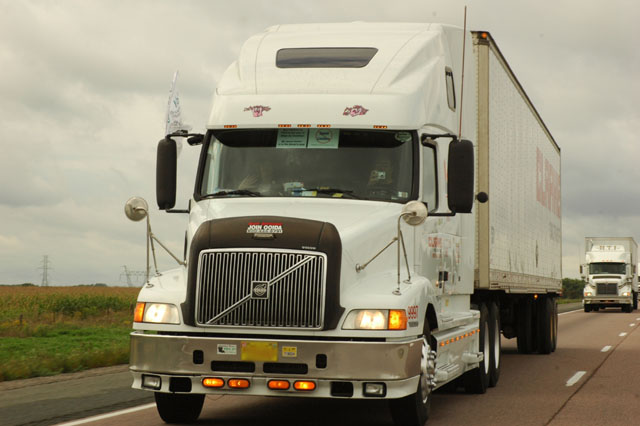
Since September 2001, on my truck, there is a yellow ribbon on each side to show my support. After the years, they faded out and were hard to see on a white cab. On a fuel stop at the Irving in Cornwall, I saw on the counter red ribbons with a Canadian flag and the mention “Support our troops”. The profits are for care packages for our troops that greatly need them.

I have often said the event if we don’t agree with the decision of our elected officials about where the troops are sent, these men and women deserve our support for the job they do and when they come home.

If you feel like dropping them a good word to help them keep their moral up, here is the web link to do so

http://www.forces.gc.ca/site/community/messageboard/message_add_e.asp

Jean Catudal

5/01/2007

Mexican Trucks and Driver, Part 2


While, north of the Mexican border, our neighbours are wondering how to keep a possible flow of uncertainty about trucks coming from the south, we are wondering what can happen if we loose the buffer zone crated by the whole country of the USA. As I have written earlier, my view is more on the financial impact of the outpour then the trucks and the drivers with non verifiable skills and records.

In this whole question of letting Mexican trucks run freely north of the actual buffer zone along the southern border, one concern is coming out from them too. In 2001, the Mexican government has been petitioned by a group called “CANACAR”. This group seems to be about the equivalent of our Canadian Trucking Alliance or of the American Trucking Association. CANACAR, in 2001, had asked the Mexican Senate to cancel the trucking section of NAFTA, as reported in Land Line Magazine. Still today, CANACAR is claiming no real benefits to open the borders.

In the appearance to the Mexican Senate, the president of the group, Tirso Martinez Angheben, expressed the following points to stop the American Pilot Program.

  • Transportation prices in Mexico are lower than in the USA or Canada;
  • It will cause transportation prices in Mexico to increase;
  • It will not accelerate the border crossing process;
  • It will generate strong pressure on salaries paid to Mexican drivers, which in turn will increase the cost of domestic freight in Mexico; and
  • The Mexican government lacks the capacity and infrastructure to supervise U.S. carriers entering Mexico and to prevent foreign companies from providing domestic transportation only reserved for Mexican nationals.

Don’t we have the same concerns but the other way around?

  • Transportation prices in Canada are higher than in Mexico;
  • It will cause transportation prices in Canada to decrease;
  • It will not accelerate the border crossing process;
  • It will generate strong pressure on salaries paid to Canadian drivers; and
  • Can the Canadian government have the capacity and infrastructure to supervise any carriers entering Canada and to prevent foreign companies from providing domestic transportation only reserved for Canadian citizens?

These are some talking points that the associations representing carriers, owner-operators and drivers could sit down to see the full impact on our industry here in the great white northern.

Jean Catudal

4/26/2007

What can I do during the World wide road safety week?


I was wondering on that question this week and I am asking you to think about it too. I have put as head liner the bumper sticker that OOIDA gives away to promote the “Run Compliant” program. This says a lot and we read beyond the message to see the big picture.

The first thing a professional driver should do, keep a legal log book. I can hear you sitting in front of your keyboards…Please watch you vocabularies…It isn’t nice for the ears…

I am also one that makes a living driving a big truck and I know that when the wheels don’t turn, there are no incoming revenues. Being between two contracts and facing all kinds of twists and turns that are keeping me at home, I will be tempted to bend and stretch the creativity of my log. But guess what? I won’t. I did it before and I am still alive, hate well every day and I faced my financial duties just the same. I will admit that I did cut on some fancy stuff. I still have a laptop that is over 3 years old, I am not on the cutting edge of communication technologies such as Blackberry, satellite internet or TV.

Running compliant is also to drive at posted speed limits. I know some states and provinces do have some tolerance. I do use some of it but, 100Km/h is not 120. Without claiming to be a scientific analyst, I do read local papers and watch newscasts here and there and, on many Mondays, I noticed that most fatal accidents did occur on secondary highways, in towns or cities. When a wreck happens on a limited access highway, it’s a bad one. These are usually caused by driving too fast for the conditions or, simply by following too closely.

In a nut shell, running compliant pays is less stressful and mostly safer!

On these words, you all have a good road safety week and a good road safety year.

Jean Catudal

4/25/2007

I was taking a break

I am leaving this message just to let you know I was taking a short break. The last few weeks were quite busy for me. My participation to the first leg of the World's Largest Truck Convoy for Special Olympics took a lot of my time.

We, the orginizers, had the support of Newcom Business Media to be part of Expocam in Montreal the 12th to the 14th of April. It did give us a lot of exposure to let the word out about this wonderful event. We are sure this will be a blast!

I invite you to use the link on the sidebar to go look up the latest news on the convoy that will be posted on a special blog I have put up. www.qcconvoy.blogspot.com

I am still doing some updates on the entrance of the Mexican trucks in the USA and Canada. The impact that this will make and the views I can read from all across North America. This should be up in the next few days.

Thanks for your patience.

Jean Catudal

3/15/2007

Mexican Trucks and Drivers, The Doors of Canada Are Wide Open!


Ever since NAFTA has been signed, our American neighbours have tried to stall the outpour of Mexican domiciled trucks out of the buffer zone of 20 miles. The ones of us that do go in that zone have seen the type of trucks the Mexican carriers are using. Anything that American carriers can’t sell on the American or Canadian markets is shipped there. If you want to see old orange C.O.E’s that were on the Schneider fleet, just drive to Laredo or Brownsville. I can tell you that the Green Bay carrier has stopped buying those over eight years ago. I was driving there at the time.

Mexican carriers must meet all safety and compliance rules, just like we do us Canadians, to gain access out of the buffer zone. Currently for us, that zone is 2500Km away from our border and accordingly to my sources, nothing is there to stop them to get on our roads once they gain access to the USA.

The pilot project of USDOT and FMCSA includes 100 Mexican based carriers but, no limits on the number of units of each fleet should start in less then 60 days. Many opposing groups such as Teamsters, OOIDA and the Public Citizen Group have joined forces. At Transport Canada, I was told that if these carriers meet the standards they will be allowed here.

These standards are the same for us and include, drug testing, valid insurance tags, trucks that are compliant with all laws and regulations from the CVSA point. This is not what Jim Hoffa International President of Teamsters declared in a Congressional Hearing.

“There will be no meeting of those requirements,” he said. “I am convinced that neither the U.S. nor the Mexican governments have the resources to carry out an aggressive oversight and enforcement program.”

Just a few American carriers did ask for a permit to run south of the border. I don’t want to speculate but, we know a few names. Some other points are tickling our US neighbours. It is a one way pilot program and no American based carrier can let their truck in Mexico before at least 6 months, and all Mexicans can be allowed in after the program.

What we, as Canadians, have to worry about more, I think, is all the economics of that opening. The large manufacturers that are already exporting to Mexico, to save on production costs, won’t be shy to hire a Mexican carrier that will have a lower cost by paying less their drivers. All that really matter for them is to show the stockholders a profit. Why do you think so many have already moved to Monterrey?

I was reading a few months ago in a trade publication that soon Canadian trucks are going to be made in Mexico. Navistar is looking at the idea and Freightliner as announced the opening of a new assembly plant there at the cost of $300M to assemble the Sterling Trucks there. If I remember well, they had also announced 800 job cuts at the St-Thomas Ontario plant last December. When will that plant close for good?

I ask the CEO’s of the large Canadian carriers and their associations to join in with the small business truckers associations to lobby the governments to stop that insanity. Putting new rules and regulations is not the way to level the paying field for us.

Jean Catudal

3/14/2007

World's Largest Truck Convoy for Special Olympics Quebec

Being involved in the first leg of the convoy in Quebec as a spokeperson, I am proud to announce that the 20 first truckers to enroll for the convoy before March 31st, will receive a pass to enter Expocam 2007


We will be pleased to see you there from April 12th to 14th at Place Bonaventure. Easy to get them, just drop us an email and we will return the entry forms to you promptly.

convoi.qc.os@sympatico.ca

Be on the lookout for our trailer on the roads of Quebec and North America!

Hoping to see you there!

Jean Catudal Spokeperson and all the Team of the Convoy!

Sharing my views on driver pay and leases to O/O’s


If private Bill 115 in Ontario passes the third reading and the proposed rule making of the FMCSA on EOBR’s takes place in the next two years, it’s all of the pay system that will need a serious look over and to be updated with these new realities. I always thought that for a same load, to a same place from a same shipper, an equal pay should be handed out. When a company I worked for changed from hub miles to practical computer miles, I was on the band wagon because, if two drivers taking different routes, the one that took the best way should not get a smaller pay then the one that did a detour for personal reasons. Now with all the demands of the large carriers associations, I changed my views. My life and work experience also have motivated my change of thoughts.

If I can quote CTA’s president Mr Claude Robert in his acceptance speech:” It’s time the industry takes seriously the hours of service rules” and he followed in the same speech saying that paper logs are out of control and a joke. I agree that EOBR’s are one good way for carriers to charge the waiting time to the shippers and receivers that will hold equipment to their docks for too long.

You all know the old comment we make that we are the only workers that can get a fine for working overtime. My thinking, well my new thinking doesn’t stop there now with the steps forward on the issues of EOBR’s and speed limiters.

I don’t claim to know the truth but, I will share my thoughts and my views with you, by using a logical approach to the problem.

Which part of our work is the easiest?

On a nice sunny day, cruising down a nice four lane highway, within the speed limits, this is when we rake in the most income. If you run 65mph, multiply that by your mile rate, and you will have your hourly pay.

Which is the hardest part of our work?

In a heavily congested urban area, like Toronto or Chicago, when to travel a distance of 65 miles, you can take two and a half hour at an average of 26mph. In this case you will earn less then half of your income with twice the stress and aggravation.

Don’t get me wrong, I am not in for unions either. I’m a free thinking person that enjoys his freedom of choice in a work field I love. More and more demands and rules in our industry are pushing me in these thoughts I’m sharing with you here.

And then, all the directors of human resources are still wandering why there is such a high turnover in our industry. I will repeat that I don’t know all the truth but when a person comes to our industry from a recycling or a career change, and that person always had an hourly pay, working conditions in agreement with the labour boards or a unionized field, that person quickly jumps to the conclusion that we are highly exploited.

I have learned a long time ago that for the work I do as a Professional Driver, I can not look at the fruit of my labour that way. I have to look at it as a whole, adding all income and extras, then I consider myself to make a more then average pay. If I add up all the advantages that comes with it, seeing a lot of the country, not having a boss looking over my shoulder or making sure I am productive. We are paid by the distance we go or by contract. The main goal is that we get the loads where they need to be in time and safely.